Choosing the right fabric shapes comfort, durability, appearance, and environmental impact. The question is practical: what fabrics are best for women's clothes? The answer depends on climate, garment purpose, skin sensitivity, care habits, and expected lifespan.
Cotton remains familiar, breathable, and versatile for shirts, dresses, and everyday underwear. Organic cotton may reduce some agricultural impacts, but certification and farming practices still require careful review. Linen performs well in hot weather because its open structure encourages airflow. It wrinkles easily. That is part of its character, not always a defect. Wool offers warmth, odor resistance, and strong performance in coats, knitwear, and travel clothing. Fine wool can feel comfortable, although sensitive skin may disagree.
Silk provides a smooth hand feel and natural temperature regulation, while lyocell delivers softness and useful moisture management. Recycled polyester supports sportswear and quick-drying designs, but it remains a synthetic fiber and can release microfibers. There is no perfect fabric.
Textile Exchange’s Materials Market Report 2024 recorded approximately 124 million tonnes of global fiber production in 2023. That scale makes material selection commercially and environmentally significant. Its data also shows polyester remains the dominant fiber worldwide, reinforcing the need to examine recycled content and end-of-life planning. The Ellen MacArthur Foundation links longer garment use with a more circular fashion system. That principle matters in daily wardrobes.
A reliable fabric comparison should examine fiber origin, construction, weight, finishing, washing requirements, and repair potential. A lightweight linen blouse may outperform a delicate synthetic one in summer, but not during repeated high-friction wear. The best choice is rarely the most fashionable label. It is the fabric that fits the garment’s real job and survives repeated use.
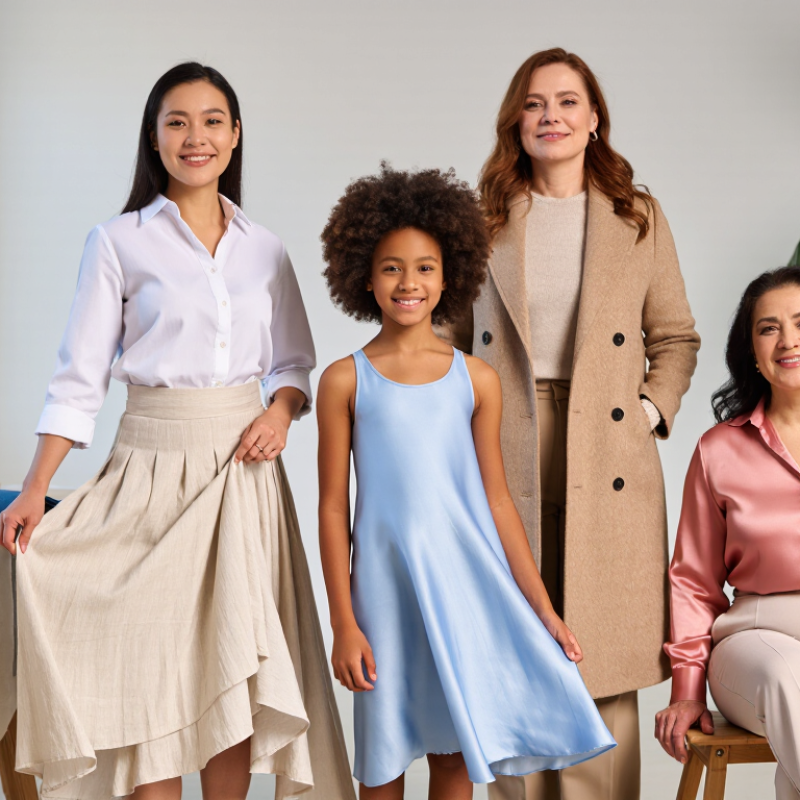
Fabric choice should begin with use, not fashion language. Textile Exchange’s Materials Market Report 2024 records 124 million tonnes of global fiber production in 2023. Polyester represented about 57%, while cotton accounted for roughly 19%. These figures show scale, not quality. For women’s clothing, performance means abrasion resistance, dimensional stability, moisture control, thermal comfort, and safe care. A fitted blouse needs different evidence from a winter coat. No fiber wins every test.
Polyester can dry quickly and retain shape, which suits active or travel garments. Yet its fossil origin and shedding potential require scrutiny. Cotton offers softness and breathability, but its water and land impacts vary sharply by farming practice. Wool can buffer temperature, while lyocell-type cellulosics may provide a smooth hand feel. Textile Exchange’s 2024 data also shows recycled fibers remain a minority of total supply. That matters. A recycled claim needs source, percentage, and verification, not just a green-looking label.
Durability deserves more weight. WRAP’s Valuing Our Clothes report estimates that extending a garment’s life by nine months can reduce its carbon, water, and waste footprints by about 20%. Test seam strength, pilling, colorfastness, and shrinkage after repeated laundering. Ask whether the fabric still feels good on the tenth wear. This is where material rankings become imperfect. A theoretically lower-impact fiber may fail early, while a repairable garment performs better in practice. I would record fiber content, finishing chemistry, care temperature, and expected service life before calling any fabric “top.”
Choosing fabric for women’s clothing requires more than touching a sample. Weave, weight, finishing, and garment design affect performance. A loose cotton shirt may feel cooler than tightly woven linen. Textile Exchange’s Materials Market Report 2024 estimated global fiber production at about 124 million tonnes in 2023, with cotton representing roughly one-fifth of output. Cotton remains comfortable, absorbent, and widely available. It can trap moisture, however, especially in humid weather.
Linen performs strongly in hot climates. The European Confederation of Flax and Hemp reports that European flax is generally rain-fed, while flax fibers are known for high tensile strength. Linen feels airy against the skin and dries quickly. Its familiar weakness is wrinkling. That is not a quality failure, but many wearers dislike the lived-in appearance. Hemp offers impressive durability and usually becomes softer after repeated washing. Industry guidance from the European Industrial Hemp Association also highlights hemp’s strong bast fibers. Yet roughness can remain when the yarn or finish is poorly selected.
No fabric wins every comparison. Cotton often gives the softest first impression. Linen usually feels breezier. Hemp may handle repeated wear better. A 2023 review in the Journal of Natural Fibers notes that moisture transport depends heavily on fabric construction, not fiber identity alone. This matters when shopping. Check the fabric weight, weave, and care label. Touch the inside seam. A lightweight hemp blend may outperform heavy linen in daily comfort, while plain cotton may lose shape sooner. The comparison is useful, but never perfectly tidy.
Polyester remains a practical base for women’s everyday clothing. Textile Exchange’s Materials Market Report 2024 estimates that polyester represented about 57% of global fibre production in 2023. It dries quickly, holds color well, and resists repeated washing. However, dense polyester can feel warm against the skin. A breathable knit structure often matters more than the fibre name alone.
Nylon usually feels smoother and stronger than polyester. It works well in leggings, fitted tops, and lightweight outer layers. Industry testing commonly evaluates abrasion resistance, dimensional stability, and recovery after stretching. Nylon often performs strongly in these areas, but it can cost more and may show body oils faster. Softness is not enough. Fabric weight and finishing change the wearing experience.
Elastane provides the stretch that improves movement and fit. It is rarely used alone. A small percentage can give waistbands, jersey dresses, and active trousers useful recovery. The precise amount depends on the garment’s purpose. Too little creates tight, restrictive clothing. Too much may reduce durability, especially with heat, chlorine, or harsh washing. The European Chemicals Agency highlights careful fibre and garment-care assessment for longer product life. In practical fitting tests, polyester-elastane blends often balance cost, quick drying, and comfort. Nylon-elastane blends can feel smoother and recover faster. That trade-off matters. Fit changes everything. A promising fabric can still fail when seams twist, fabric pills, or recovery weakens after repeated wear. (Sources: Textile Exchange, Materials Market Report 2024; European Chemicals Agency, textile sustainability information.)
| Performance Dimension | Polyester | Nylon | Elastane |
|---|---|---|---|
| Fiber Type | Manufactured synthetic fiber commonly used in woven and knitted clothing. | Manufactured synthetic fiber known for a smooth hand and strong performance. | Manufactured elastic fiber, also called spandex, usually blended with other fibers. |
| Natural Stretch | Low to moderate Standard polyester has limited stretch; knitted construction or textured yarns can add give. |
Low to moderate Most stretch comes from knit structure or blending rather than from the nylon fiber itself. |
Very high Designed to stretch substantially and return toward its original shape. |
| Stretch Recovery | Moderate to high Generally retains shape well, especially in performance fabrics. |
High Usually recovers well from repeated movement when properly blended and cared for. |
Very high Provides the primary recovery and body-contouring function in stretch garments. |
| Moisture Management | Good Low moisture absorbency allows quick drying, although odor can remain without suitable fabric treatment. |
Good Dries relatively quickly and can move moisture through lightweight fabric constructions. |
Limited on its own Usually included in small percentages, so moisture behavior depends mainly on the companion fiber and fabric structure. |
| Breathability | Moderate Varies considerably with yarn size, knit density, and fabric construction. |
Moderate to good Lightweight and engineered constructions can feel comfortable during active wear. |
Low as a standalone fiber Breathability is determined mostly by the fibers blended with it and the overall garment design. |
| Abrasion Resistance | Good to very good Suitable for garments exposed to regular friction and frequent use. |
Very good Often selected for durable, lightweight clothing that faces repeated rubbing. |
Moderate Improves stretch but is generally protected by blending with more durable fibers. |
| Shape Retention | Very good Resists shrinking and wrinkling under normal care conditions. |
Good Maintains its form well, though excessive heat can affect the fabric. |
Good when blended Can lose elasticity over time when exposed to high heat, chlorine, body oils, or prolonged sunlight. |
| Softness and Hand Feel | Can range from crisp to soft depending on the yarn and finishing process. | Typically smooth, lightweight, and soft against the skin. | Smooth and flexible, but normally too fine to be used alone for everyday garments. |
| Care and Drying | Usually easy to wash and quick to dry; lower temperatures help reduce heat-related damage and pilling. | Usually easy to wash and quick to dry; avoid excessive heat because it may weaken or deform the fabric. | Use cool or warm washing, avoid high heat and chlorine bleach, and follow the garment's care label. |
| Best Everyday Uses | Everyday tops, dresses, skirts, trousers, uniforms, activewear, and easy-care travel clothing. | Activewear, swimwear, hosiery, lightweight dresses, lingerie, outer layers, and durable travel garments. | Leggings, fitted dresses, jeans, underwear, swimwear, sportswear, and any garment requiring close fit. |
| Main Advantages | Durable, quick-drying, wrinkle-resistant, shape-retaining, and generally cost-efficient. | Strong, lightweight, smooth, abrasion-resistant, and comfortable for movement. | Provides exceptional stretch, flexibility, body fit, and recovery in blended fabrics. |
| Main Limitations | May retain odors, generate static, pill in some constructions, and feel less breathable in dense fabrics. | Can be sensitive to high heat, may retain odors, and can cost more than comparable polyester fabrics. | Can degrade with high heat, chlorine, oils, and prolonged ultraviolet exposure; rarely provides enough structure alone. |
| Overall Suitability for Everyday Wear | Excellent for easy-care clothing A practical choice when durability, quick drying, and wrinkle resistance are priorities. |
Excellent for lightweight durability A strong choice when smoothness, abrasion resistance, and mobility are important. |
Best as a blend component Ideal for adding stretch and recovery to polyester, nylon, cotton, and other apparel fabrics. |
Note: Actual performance depends on fiber quality, blend percentage, yarn construction, fabric weight, finishing treatments, garment design, and care practices.
Wool, silk, and lyocell manage body heat in different ways. The International Wool Textile Organisation reports that wool can absorb up to 30% of its weight in moisture vapor. It still feels relatively dry. Its crimp traps small air pockets, creating insulation around the body. This suits winter skirts, knit dresses, and tailored layers. However, wool may feel bulky in humid weather. Fine fibers also require careful washing.
Silk offers lighter insulation. Textile references commonly report silk’s moisture regain near 11%, allowing it to absorb perspiration without immediately feeling damp. Its smooth surface feels cool against warm skin, yet it provides gentle warmth under a jacket.
Lyocell typically shows moisture regain around 11–13%, according to published textile-fiber property data. Its fiber structure supports moisture absorption and a soft, fluid drape. Textile Exchange’s 2024 Materials Market Report places lyocell within the growing manmade cellulosic category, but fiber performance still depends on yarn design, fabric weight, and finishing. That detail matters. “Lyocell” alone does not guarantee superior moisture control.
Tips: Touch the fabric after movement, not only before dressing. Wear wool for cold, variable conditions. Choose silk for lightweight layering. Try lyocell for humid commutes and relaxed clothing. Check the care label carefully. I would not treat laboratory moisture figures as promises for every garment; blends, dyes, and tight weaves can change the experience. A small underarm test may reveal more than a specification sheet.
For everyday shirts and summer dresses, linen ranks first for breathability and low-fuss comfort. Its dry texture feels cool against the skin. Cotton follows for softness, availability, and easy care. However, irrigation can change cotton’s impact dramatically. Organic farming may reduce chemical inputs, but it does not automatically mean low water use. Textile Exchange’s Materials Market Report 2024 reports 124 million tonnes of global fiber production in 2023, with cotton contributing about 22%.
Lyocell is a strong choice for smooth dresses, underwear, and relaxed trousers. Its wood-based fiber can offer efficient solvent recovery when production systems are well managed. Wool ranks highly for knitwear and winter layers because it regulates temperature and resists odor. Its footprint still includes land use, feed, and methane emissions. The ranking is useful, but imperfect. Fiber choice cannot replace durable design.
For sportswear, stretch garments, and rain shells, recycled polyester offers the best performance-to-impact balance among common synthetics. Nylon provides strong abrasion resistance, especially in fitted activewear. Yet both materials can release microfibers during washing. Polyester dominated global fiber output at roughly 57% in 2023, according to Textile Exchange. Recycled polyester represented about 14% of polyester production, showing progress but limited scale. For lower-impact wardrobes, durability matters as much as fiber origin. WRAP’s Valuing Our Clothes report found that extending clothing life by nine months could reduce carbon, water, and waste footprints by around 20–30%. That result deserves more attention.
Comparative suitability scores from 1–10, based on commonly documented fiber properties such as breathability, moisture management, durability, thermal performance, and drape. Environmental impact is shown as a relative category rather than a complete life-cycle assessment.
How to read this chart: Linen and cotton perform well in warm-weather clothing, wool is strong for insulation and tailoring, and polyester and nylon are highly suitable for activewear because of their durability and quick drying. Fiber impact varies with farming, energy sources, manufacturing, durability, washing, and end-of-life conditions.
Linen usually feels the breeziest. Its dry surface and quick drying suit hot days. Loose cotton can feel cooler than tight linen.
Cotton often feels soft immediately. It absorbs moisture and is easy to find. In humid weather, it may hold sweat against your skin.
Hemp often handles repeated use well. It can soften after washing. Rough yarn or poor finishing may still feel uncomfortable.
Linen wrinkles naturally. That is not necessarily a defect. Smooth it by hand after washing, or accept the relaxed appearance.
Wool suits cold, changing conditions. Its crimp traps small air pockets. Fine wool needs gentle washing and may feel bulky in humidity.
Silk works well for lightweight layers. Its smooth surface feels cool on warm skin. Wear it under a jacket or thin sweater.
Lyocell can absorb moisture and drape softly. It suits relaxed trousers, dresses, and humid commutes. Results vary with weave, weight, and finishing.
Check the fabric weight, weave, and care label. Touch the inside seam. Move your arm, then notice heat and dampness. A small test helps, but it is not perfect.
No single fiber always wins. Durable design matters greatly. Extending a garment’s life can reduce its overall footprint. I would avoid trusting one label alone.
Recycled polyester balances performance and impact fairly well. Nylon resists abrasion in fitted activewear. Both can release microfibers during washing. The comparison remains incomplete.
Choosing the right fabric for women’s clothing depends on comfort, breathability, durability, stretch, insulation, moisture control, and overall fiber impact. Cotton offers softness and everyday comfort, while linen provides excellent airflow for warm weather. Hemp is highly durable and breathable, making it suitable for long-lasting garments. Polyester and nylon are practical choices for activewear because they offer strength, quick drying, and easy care, while elastane adds flexible stretch for movement and a comfortable fit.
Wool and silk perform well in temperature regulation, with wool providing warmth and moisture management and silk offering a lightweight, smooth feel. Lyocell is another strong option, combining softness, breathability, and effective moisture control. Based on different use cases, cotton and linen suit casual summer clothing, hemp supports durable wardrobe staples, synthetic blends work well for performance garments, and wool, silk, and lyocell offer specialized comfort. Ultimately, what fabrics are best for women's clothes depends on the garment’s purpose, climate, desired feel, maintenance needs, and fiber impact.
